The beloved author spent her days and nights in a 1960s house built by Frank Lloyd Wright's grandson.
02.23.26 — via Absolument !
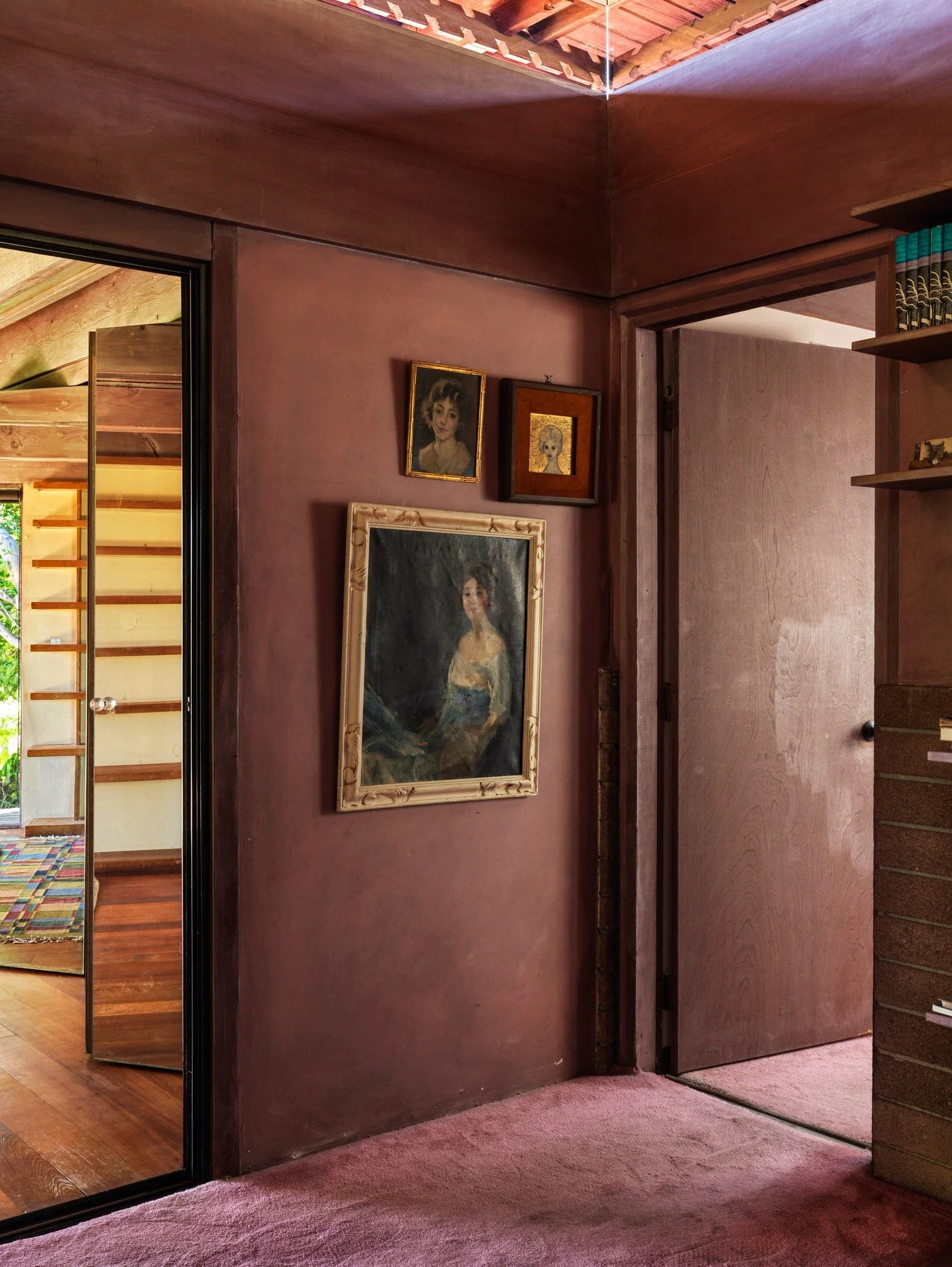
< photograph by Chris Mottalini for the New York Times
I spent many years living in Los Angeles, working at an internationally known mid-century home, attending architecture preservation meetings to keep this style of architecture alive, creating and signing up for home tours, and familiarizing myself with any and every structure built in the City of Angels between 1935 and 1975.
As soon as my eyes fell on Nin’s home, I knew it was architecturally significant!
The hyper-specific brickwork that resembled the Usonian homes of Frank Lloyd Wright was my first clue, and a close second was the Japanese-inspired feeling of the Shoji screen-esque room dividers, wood-paneled walls, and low wooden ceilings. These elements reminded me of R.M. Schindler’s Kings Road House.
In turns out, the home’s architect was Eric Lloyd Wright. The grandson of Frank, and son of Lloyd Wright—also an architect. Which means: Anais Nin’s house was technically the grandson of a FLW house.
Anais and her husband, actor Rupert Pole, commissioned Eric Lloyd Wright to build this 1399-square-foot home for them in 1962. Another important connection: Rupert and Eric were half brothers. Both men had a sense of urgency about building a residence and surrouding gardenscape that mimicked a Japanese temple.
The home’s Douglas fir walls contained partitions that could divide or open the living spaces, primarily the living room and the couple’s bedroom. The single-story profile had ceilings that held themselves low to the ground, much like the homes scattered throughout Japan. “Even the roof, supported by large beams, provided an impression of protection,” Anaïs reported in the sixth volume of her diaries. The “house with mirrors where a golden light curls up on things. . .It had the sense of space of Japanese houses. . .all sky, mountains, lake, as if one lived out of doors.” The living room looked out at a a pond and rock garden; the first layer before the Silver Lake Resevoir reveals itself in the distance.